Contact the Find a Tender team (opens in new tab) if you have feedback, questions or suggestions.

Back Find a tender

Help & Support for Summarised Search

What is Summarised Search?

Summarised Search is a new feature on Find a Tender (FTS) that gives you the latest view of a procurement. This is different from Notice Search, which returns individual notices published at a specific point in time. Summarised Search allows you to see the current stage of a project or contract rather than a list of historical events.

There are three ways to search:

  • Opportunities: Use this to find procurement pipelines and active tenders. Each result represents one procurement process.
  • Contracts: Use this to see awarded contracts and their current status. Each result represents one contract.
  • Commercial Tools: Use this to find frameworks, dynamic markets and dynamic purchasing systems that public sector buyers use to buy goods, services and works. Each result represents one lot or part within a commercial tool.

Built on PA23 Data

This product is only possible because of the improved data quality introduced by the Procurement Act 2023 (PA23). The data published under PA23 is more structured and covers more of the commercial lifecycle, enabling more advanced search tools.

Please note the data scope:

  • Opportunities and Contracts: These searches only cover procurements published from 24th February 2025, when the PA23 came into force.
  • Commercial Tools: This search combines PA23 data with a legacy dataset to help users find active, older frameworks set up under previous legal regimes.

Summarised Search is not the official record. These searches bring together information from all notices published for a procurement to give you a current, summarised picture. It does not constitute the official publication under the Act. To see the detailed publication under the Act, or for information relating to other legal regimes, please use Notice Search.

How the data is compiled

The data in FTS is published using the Open Contracting Data Standard (OCDS), an open data standard for publishing machine-readable data about public procurement. In OCDS, each procurement gets a unique identifier, called an OCID, that links together all the notices published at different stages of that procurement, from planning through to contract implementation.

Procurement notices are usually published one at a time to record a specific event. For example, a Tender Notice (UK4) advertises an opportunity, and a Contract Award Notice (UK6) records the award decision made.

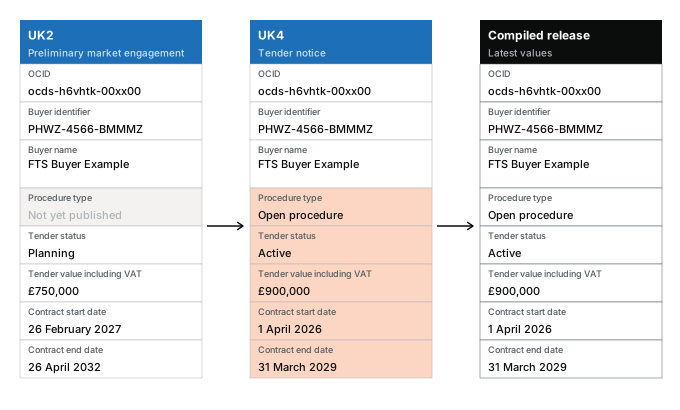
To provide a current-state view, Summarised Search uses a standard feature of OCDS called a compiled release - this is where the data from individual notices is bundled into a single up-to-date record per procurement. This means that when a procedure is updated - for example, when a tender is cancelled or contract is awarded - you always see the most recent information in one place, rather than having to look through multiple historical notices.

Example: Visualising a compiled release

Visualising a compiled release

Targeted interventions for better usability

While the majority of Summarised Search is a direct reflection of raw data published by contracting authorities, in specific cases fields have been calculated or derived to improve how you filter and sort the data. Without these targeted calculations, search results can often be misleading due to how notices are legally required to be published.

For example, buyers are not legally required under the Procurement Act 2023 (PA23) to publish a Contract Termination Notice for smaller (below-threshold) contracts. Without this closure notice, the raw data will show these contracts as “Active” indefinitely.

To provide a more accurate picture, Summarised Search applies the following logic once a below-threshold contract passes its maximum end date.

  • Contract Status: The status is automatically updated to “Closed”.
  • Reasons for Closure: This field is set to “Below-threshold assumed completed”.

These interventions are designed to help you find the right information quickly. Field definitions and calculation methods are fully documented in the following ‘About’ sections.

Technical access

If you are a developer or advanced data user, full notice data is available in OCDS JSON format via the Find a Tender API.

About Opportunities

The Opportunities search shows planned procurements and active tenders under the Procurement Act 2023 (PA23). Each result represents one procurement process (OCID).

How to use this search

  • For Suppliers: Find upcoming bidding opportunities for public sector contracts. You can build market intelligence, such as tracking preliminary market engagement events in your sector.
  • For Buyers: Search for procurement pipelines to identify opportunities to work collaboratively.
  • For Citizens and Civil Society: View procurement plans in the areas you care about, such as by sector or contracting authority.

Data Dictionary

Field Name Description Technical Logic
Procurement identifier (OCID) A globally unique reference code for each procurement. Used to link all notices, awards and contracts under one contracting process. Value taken directly from ocid
Procurement Title The name of the procurement as published by the contracting authority. Value taken directly from tender.title
Contracting Authority The name of the organisation responsible for this procurement. Where more than one contracting authority is involved, the lead buyer is shown first, followed by the additional buyers. Comma separated list of parties.name where parties.roles contains 'buyer'
Contracting Authority Type The classification of the Contracting Authority as defined in the Procurement Act 2023. Possible values are: Central government, Regional and local public authority, Public undertaking, Private utility, Other. Based on parties.details.classifications.description where parties.details.classifications.scheme is 'UK_CA_TYPE'
Opportunity Status The current lifecycle stage of the opportunity based on the most recent notice published. This is derived from the notice type and, for tender notices, whether the closing date has passed.
Possible values are:
- Pipeline: an early indication about potential future contracts and dynamic markets.
- Preliminary market engagement: the contracting authority is seeking input from suppliers before launching a formal tender
- Planned procurement: provides early information about a competitive procurement
- Active Tender: the opportunity is accepting submissions
Derived based on the Latest notice published value:
- 'Pipeline': Assigned when the latest notice is 'UK1',
- 'Preliminary Market Engagement': Assigned when the latest notice is 'UK2',
- 'Planned Procurement': Assigned when the latest notice is 'UK3',
- 'Active Tender': Assigned when the latest notice is 'UK4' or 'UK13'
Total Value exc. VAT (estimated) The estimated total monetary value of the procurement excluding VAT. This is the buyer's estimate at the time of publication and may not reflect the final contract value. Value taken directly from tender.value.amount
Total Value inc. VAT (estimated) The estimated total monetary value of the procurement including VAT. This is the buyer's estimate at the time of publication and may not reflect the final contract value. Value taken directly from tender.value.amountGross
Currency The currency in which the monetary values are expressed (e.g. GBP). Value taken directly from tender.value.currency
Suitability Whether a tender lot within the specific opportunity has been flagged as suitable for Small and medium-sized enterprises (SMEs), Voluntary, community and social enterprises (VCSEs), or both. Returns a suitability label based on the sme and vcse flags in tender.lots.suitability: Both true "SME-Suitable, VCSE-Suitable", sme only: "SME-Suitable", vcse only: "VCSE-Suitable"
Next Relevant Date Type A label indicating the next key milestone for this opportunity. The type of date displayed depends on the 'Opportunity Status', the latest notice published and whether certain date fields are populated.
- "Tender or Transparency Notice Publication Date (estimated)", where status is Pipeline and tender.communication.futureNoticeDate is not null
- "Contract Start Date (estimated)", where status is Pipeline and the tender.communication.futureNoticeDate is not available.
- "Engagement Deadline Date" where status is Preliminary Market Engagement
- "Tender Publication Date (estimated)" where status is Planned Procurement
- "Submission Deadline Date" where status is Active Tender
- "Dynamic Market Start Date (estimated)" where status is Active Tender and the latest notice is a UK13
Next Relevant Date The specific calendar date associated with the next key milestone for this opportunity The date displayed depends on the 'Opportunity Status', the latest notice published and whether certain date fields are populated.
Where the Opportunity Status is:
- 'Pipeline': The value is taken from tender.communication.futureNoticeDate. If not populated, use the minimum tender.lots.contractPeriod.startDate where tender.lots.status is not "cancelled".
- 'Preliminary Market Engagement': The value is taken from planning.milestones.dueDate where planning.milestones.type = "engagement" AND planning.milestones.status = "scheduled", else use planning.milestones.dateMet where planning.milestones.type = "engagement" AND planning.milestones.status = "met".
- 'Planned Procurement': The value is taken from tender.communication.futureNoticeDate.
- 'Active Tender' AND the latest notice published is UK4: the value is taken from tender.tenderPeriod.endDate; if not present, use tender.expressionOfInterestDeadline. If both tender.expressionOfInterestDeadline and tender.tenderPeriod.endDate are populated, then tender.procurementMethod should be used to determine the priority: If tender.procurementMethod = 'open' use tender.tenderPeriod.endDate else use tender.expressionOfInterestDeadline.
- 'Active Tender' AND the latest notice published is UK13: the value is taken from tender.techniques.frameworkAgreement.period.startDate
Contract Start Date (estimated) The anticipated date on which the buyer expects the contract to begin. The minimum tender.lots.contractPeriod.startDate where tender.lots.status is not "cancelled"
Contract End Date (estimated) The anticipated date on which the buyer expects the contract to end. The maximum tender.lots.contractPeriod.startDate where tender.lots.status is not "cancelled"
Main Procurement Category The primary category of the procurement: either goods, services or works. Value taken directly from tender.mainProcurementCategory
CPV Classifications The Common Procurement Vocabulary (CPV) codes and descriptions - a standardised classification system for describing the subject matter of public contracts. Value taken directly from tender.items.additionalClassifications.id and tender.items.additionalClassifications.description
Contract Delivery Locations The geographical regions where the goods, services or works will be delivered, shown as a region code and name. Value taken directly from tender.items.deliveryAddresses.region with the corresponding region name included
Procurement Description A summary of the procurement requirement. It expands upon the Procurement Title to specify the nature, scope, and core requirements of the goods, services, or works being sought. Value taken directly from tender.description
Procedure Type The method chosen for the procurement process. Value taken directly from tender.procurementMethodDetails
Commercial Tool Indicates if this opportunity seeks to establish a framework or a dynamic market. Returns a commercial tool label if either tender.techniques.hasFrameworkAgreement or tender.techniques.dynamicPurchasingSystem are true
Special Regime Indicates if the opportunity falls under specific public procurement rules (e.g. light-touch regime, defence and security). Value taken directly from tender.specialRegime
Procurement URL The direct link to the related notices for this opportunity in Find a Tender. Value derived by combining the FTS base URL ('https://www.find-tender.service.gov.uk/procurement/') with the ocid
Procurement Reference (Local ID) A unique reference number generated by the contracting authority to manage the procurement within their own system. Value taken directly from tender.id where it does not begin with "ocds"
Lead Contracting Authority The name of the lead organisation responsible for this procurement. Both the authority name and identifier are shown. Value taken directly from buyer.name and buyer.id where parties.identifiers.scheme = 'GB-PPON'. Where the identifier does not equal 'GB-PPON' the value is based on parties.additionalIdentifiers.scheme and parties.additionalIdentifiers.id, where parties.additionalIdentifiers.scheme = "GB-PPON". If there is no identifier where parties.additionalIdentifiers.scheme = "GB-PPON" it uses buyer.id

About Contracts

The Contracts search shows awarded contracts and their current status under the Procurement Act 2023 (PA23). Each result represents one contract.

Contracts for the establishment of commercial tools (such as the setting up of a framework agreement) are excluded from this search, but subsequent call-offs are included as these represent actual contracts for goods, services or works.

Additionally, please note that Summarised Search does not reflect proposed contract modifications (where the UK10 Contract Change Notice was published in advance of the modification) as we cannot verify whether proposed amendments were ultimately executed.

How to use this search

  • For Suppliers: Track upcoming contract expiration dates to identify future bidding opportunities early. You can review the historical contract value and scope of work to help plan your pipelines and support your own competitive bids.
  • For Buyers: Use market insights from other contracting authorities to inform your own procurement strategies. This allows you to map market capability, such as identifying active suppliers in your sector by looking at who wins contracts under specific CPV codes.
  • For Citizens and Civil Society: View awarded contracts in the areas you care about to help you understand how public money is being spent and who it is being spent with.

Data Dictionary

Field Name Description Technical Logic
Procurement identifier (OCID) A globally unique reference code for each procurement. Used to link all notices, awards and contracts under one contracting process. Value taken directly from ocid
Identifier A globally unique reference code for each contract. Value derived by combining ocid and contracts.id
Contract Title The title of the contract as published by the contracting authority. Where a contract-specific title is not available, the procurement title is shown instead. Value taken directly from contracts.title, if missing, uses tender.title
Contracting Authority The name of the organisation responsible for this procurement. Where more than one contracting authority is involved, the lead buyer is shown first, followed by the additional buyers. Comma separated list of parties.name where parties.roles is 'buyer'
Contracting Authority Type The classification of the Contracting Authority as defined in the Procurement Act 2023. Possible values are: Central government, Regional and local public authority, Public undertaking, Private utility, Other. Based on parties.details.classifications.description where parties.details.classifications.scheme is 'UK_CA_TYPE'
Contract Status The current status of the contract. Value is set to 'Closed' if contracts.status = 'terminated', or if contracts.aboveThreshold = false and 'Contract end date' is in the past, else the value is taken from contract.status
Reasons for closure The reason the contract was closed or terminated, where this has been recorded. Where 'Contract Status' is 'Closed' AND contracts.aboveThreshold is 'false' AND contracts.terminationRationaleClassification.id is null AND contracts.terminationRationaleClassifications is null, the value is set to 'Below-threshold - assumed completed'. Else the value is taken from contracts.terminationRationaleClassification.id if populated, if null uses contracts.terminationRationaleClassifications
Contract Signature Date The date the contract was entered into. In most cases, this is the date the contract was signed by the last party. Value taken directly from contracts.dateSigned
Contract Start Date The date on which the contract is due to commence. Value taken directly from contracts.period.startDate
Contract End Date The date on which the contract is due to end. Based on contracts.implementation.endDate. If missing, uses contracts.period.maxExtentDate if populated, else uses contracts.period.endDate
Contract Value exc. VAT The total value of the contract excluding VAT. Value taken directly from contracts.implementation.finalValue.amount, if missing uses contracts.value.amount
Contract Value inc. VAT The total value of the contract including VAT. Value taken directly from contracts.implementation.finalValue.amountGross, if missing uses contracts.value.amountGross
Currency The currency in which the monetary values are expressed (e.g. GBP). Value taken directly from contracts.implementation.finalValue.currency, if missing uses contracts.value.currency
Suppliers The names and identifiers of the suppliers awarded the contract. Based on awards.suppliers.name and awards.suppliers.id (if parties.additionalIdentifiers.scheme = 'GB-PPON')
Supplier Type Indicates whether the contract was awarded to at least one Small and medium-sized enterprise (SME), Voluntary, community and social enterprise (VCSE), or contains both. Returns "SME" if parties.details.scale = true and "VCSE" if parties.details.vcse = true, for any awards.suppliers.id linked to the contract. (Returns "SME; VCSE" if both are true)
Threshold Whether the total value of this contract is above or below the relevant procurement threshold. Returns 'Above the relevant threshold' if contracts.aboveThreshold = true and 'Below the relevant threshold' if contracts.aboveThreshold = false
Main Procurement Category The primary category of the contract: either goods, services or works. Value taken directly from awards.mainProcurementCategory where awards.id equals contracts.awardID
CPV Classifications The Common Procurement Vocabulary (CPV) codes and descriptions - a standardised classification system for describing the subject matter of public contracts. Value taken directly from awards.items.additionalClassifications.id and awards.items.additionalClassifications.description
Contract Delivery Locations The geographical regions where the goods, services or works will be delivered, shown as a region code and name. Value taken directly from awards.items.deliveryAddresses.region with the corresponding region name included
Procurement URL The direct link to the related notices for this contract in Find a Tender. Value derived by combining the FTS base URL ('https://www.find-tender.service.gov.uk/procurement/') with the ocid
Procurement Title A short, descriptive name of the procurement that led to this contract, as published by the contracting authority. Value taken directly from tender.title
Procurement Description A detailed, free-text summary of the procurement requirement. It expands upon the Procurement Title to specify the nature, scope, and core requirements of the goods, services, or works being sought. Value taken directly from tender.description
Procedure Type The method chosen for the procurement process. Value taken directly from tender.procurementMethodDetails
Framework procedure The process by which the contract was awarded via the framework (only relevant for call-off contracts). Returns 'Competitive selection process' if tender.competitive = true and 'Award without competition' if it is false.
Framework being used The name of the framework agreement or dynamic market through which this contract was awarded (only relevant for call-off contracts). Displays the tender.title of the relatedProcesses of the contract where relatedProcesses.relationship = "framework"
Framework lot being used The specific lot of the framework the contract was awarded on (only relevant for call-off contracts). Value taken directly from relatedProcesses.relatedLots
Special Regime Indicates if the contract falls under specific public procurement rules (e.g. light-touch regime, defence and security). Value taken directly from tender.specialRegime
Procurement Reference (Local ID) A unique reference number generated by the contracting authority to manage the procurement within their own system. Value taken directly from tender.id where it does not begin with "ocds"
Lead Contracting Authority The name of the lead organisation responsible for this contract. Both the authority name and identifier are shown. Value taken directly from buyer.name and buyer.id where parties.identifiers.scheme = 'GB-PPON'. Where the identifier does not equal 'GB-PPON' the value is based on parties.additionalIdentifiers.scheme and parties.additionalIdentifiers.id, where parties.additionalIdentifiers.scheme = "GB-PPON". If there is no identifier where parties.additionalIdentifiers.scheme = "GB-PPON" it uses buyer.id
Lead Contracting Authority Address The registered address of the lead organisation responsible for this contract. Derived by concatenating parties.address.streetAddress, parties.address.locality, parties.address.postalCode, parties.address.countryName where parties.id equals buyer.id
Lead Contracting Authority Email The email address of the lead organisation responsible for this contract. Value taken directly from parties.contactPoint.email where parties.id equals buyer.id

About Commercial Tools

The Commercial Tools search shows frameworks, dynamic markets and dynamic purchasing systems that public sector buyers use to buy goods, services and works. Each result represents one lot or part within a commercial tool.

Unlike the Opportunities and Contracts searches, this search combines newer Procurement Act 2023 (PA23) data with a curated legacy dataset gathered from framework providers. This ensures you can still search and find older, active commercial tools established under previous legal regimes alongside new ones published under PA23. This dataset does not provide a fully comprehensive list of commercial tools under previous legal regimes. If you manage a commercial tool let under PCR15 which is available for other contracting authorities to use, you can add a new tool or amend an existing tool by contacting us.

How to use this search

  • For Suppliers: Identify upcoming commercial tools that you can apply to join. This is particularly helpful for small and medium enterprises (SMEs) looking to find and secure suitable long-term public sector opportunities.
  • For Buyers: Find active, pre-competed routes to market from across the public sector. This search saves you time and money by helping you identify existing commercial tools that are available for your organisation to use.
  • For Citizens and Civil Society: View up-to-date information on commercial tools in the areas you care about, to see which agreements public bodies are using to purchase goods, services, and works.

Data Dictionary for PA23 Commercial Tools

Field Name Description Technical Logic
Procurement identifier (OCID) A globally unique reference code for each procurement. Used to link all notices, awards and contracts under one contracting process. Value taken directly from ocid.
Lot identifier The unique identifier for the specific lot within the commercial tool. Value taken directly from tender.lots.id.
Commercial Tool Type The type of commercial tool used. Possible values are: Framework (PA23), Dynamic Market (PA23), Utilities Dynamic Market (PA23). Returns 'Framework (PA23)' if tender.techniques.hasFrameworkAgreement = true, or 'Dynamic Market (PA23)' if tender.techniques.dynamicPurchasingSystem = true. Where both flags are true, the notice type (UK13) is used to determine the correct type. If the result is 'Dynamic Market' and tender.techniques.frameworkAgreement.buyerClassificationRestrictions.id = 'utilities', returns 'Utilities Dynamic Market (PA23)'.
Contracting Authority The name of the organisation responsible for this tool. Where more than one authority is involved, the lead buyer is shown first, followed by the additional buyers. Comma-separated list of parties.name where parties.roles contains 'buyer'.
Commercial Tool Title A short, descriptive name of the tool, as published by the contracting authority. If a local reference has been used in the procurement, this will be prefixed to the title. Calculated by combining tender.id and tender.title. Where tender.id begins with 'ocds', the tender.id prefix is omitted.
Lot Title The name of the individual lot or part within this commercial tool. Calculated combining tender.lots.id and tender.lots.title, prefixed with 'lot' or 'part'. If tender.lots.title is null, tender.title is used instead.
Lot Status The current status of this specific lot or part within the commercial tool. Possible values are:
- Upcoming: the lot or part is not yet available
- Active: the lot or part is available for use
- Closed: the lot or part is no longer available.
For frameworks:
- 'Upcoming' if no related contracts have contracts.status = 'active' or 'terminated'.
- 'Active' if at least one related contract has contracts.status = 'active' and the lot end date is on or after today.
- 'Closed' if all related contracts have contracts.status = 'terminated' or 'cancelled', or the lot end date is in the past.

For Dynamic Markets, based on values of tender.lots.status and tender.techniques.dynamicPurchasingSystem.status:
- 'Upcoming' tender.lots.status is 'active' and tender.techniques.dynamicPurchasingSystem.status is 'Pending' OR tender.lots.status is 'planned' or 'planning' and tender.techniques.dynamicPurchasingSystem.status is blank.
- 'Active': tender.lots.status AND tender.techniques.dynamicPurchasingSystem.status are 'active'
- 'Closed': if tender.lots.status is 'cancelled' and tender.techniques.dynamicPurchasingSystem.status is not 'cancelled' OR tender.lots.status is 'active' and tender.techniques.dynamicPurchasingSystem.status is 'terminated'.
Description A description of what this lot or part covers, as published by the contracting authority. Value taken directly from tender.lots.description. If null, tender.description is used instead.
Lot Start date The date on which this specific lot or part opened. Calculated based on Lot status: For Framework lots with 'Upcoming' status uses tender.lots.contractPeriod.startDate, if missing uses the minimum of awards.contractPeriod.startDate for related awards. For 'Active' or 'Closed' framework lots use the minimum of contracts.period.startDate for related contracts. For Dynamic Markets, use tender.techniques.frameworkAgreement.period.startDate.
Lot End date The date on which this specific lot or part expires or is expected to end. Calculated based on Lot status: For 'Upcoming' framework lots uses the maximum date of tender.lots.contractPeriod.maxExtentDate or tender.lots.contractPeriod.endDate, if missing, uses the maximum of awards.contractPeriod.maxExtentDate or awards.contractPeriod.endDate for related awards. For 'Active' or 'Closed' Framework lots use the maximum of contracts.period.maxExtentDate or contracts.period.endDate for related contracts. For Dynamic Markets use tender.finalStatusDate or tender.techniques.frameworkAgreement.period.endDate. Where the end date is blank but the start date is not, displays 'Open-ended'.
Lot CPV Classifications The Common Procurement Vocabulary (CPV) codes and descriptions - a standardised classification system for describing the subject matter of public contracts. Calculated based on Lot status: For 'Upcoming' framework lots values taken directly from tender.items.additionalClassifications.id and tender.items.additionalClassifications.description, if missing, uses awards.items.additionalClassifications.id and awards.items.additionalClassifications.description of the related lot. For 'Active' or 'Closed' Framework lots uses awards.items.additionalClassifications.id and awards.items.additionalClassifications.description of the related lot. For Dynamic Markets uses tender.items.additionalClassifications.id and tender.items.additionalClassifications.description of the related lot.
Available to other contracting authorities Whether contracting authorities other than the lead buyer are permitted to use this commercial tool. Returns 'Yes' if tender.techniques.frameworkAgreement.type is 'open', 'No' if 'closed', and 'Not Specified' if blank.
Maximum fee charged to suppliers The highest rate that may be charged to suppliers for participation in this commercial tool, expressed as a percentage. Value taken from tender.participationFees.relativeValue.proportion.
Commercial Tool Status The current status of the overarching commercial tool. Possible values are:
- Upcoming: no lots are active yet
- Active: at least one lot is currently active
- Closed: all lots have closed.
Calculated from the statuses of all related lots. Returns 'Active' if any lot is 'Active', 'Upcoming' if any lot is 'Upcoming' and none are 'Active', and 'Closed' if all lots are 'Closed'.
Contracting authorities that may use the tool Information regarding contracting authorities permitted to use this tool, where access is not restricted to the lead buyer. Value taken from tender.techniques.frameworkAgreement.buyerCategories.
Contracting authority location restrictions Any geographic restrictions on which contracting authorities can use this tool, where access is not restricted to the lead buyer. Value taken from tender.techniques.frameworkAgreement.buyerLocationRestrictions.gazetteer.identifiers, with the corresponding region name included.
Award method when using the tool Describes the process by which awards can be made through the commercial tool. For Frameworks, the award method is determined by the tender.techniques.frameworkAgreement.method field. 'With Competition' assigned when the method is withReopeningCompetition. 'Without Competition' assigned when the method is withoutReopeningCompetition. 'Either with or without competition' assigned when the method is withAndWithoutReopeningCompetition. For Dynamic Markets, always returns 'With Competition'.
Lead Contracting Authority The name of the lead organisation responsible for this tool. Both the authority name and identifier are shown. Value taken directly from buyer.name and buyer.id where parties.identifiers.scheme = 'GB-PPON'. Where the identifier does not equal 'GB-PPON' the value is based on parties.additionalIdentifiers.scheme and parties.additionalIdentifiers.id, where parties.additionalIdentifiers.scheme = "GB-PPON". If there is no identifier where parties.additionalIdentifiers.scheme = "GB-PPON" it uses buyer.id
Additional Contracting Authority Any other contracting authorities that are responsible for this commercial tool, excluding the lead organisation. Based on parties.name and parties.id where parties.roles = 'buyer', excluding the lead buyer. Where parties.additionalIdentifiers.scheme = 'GB-PPON', the PPON identifier is used.
Commercial Tool Description A summary description of the goods, services or works covered by this commercial tool. Value taken directly from tender.description.
Special regime Indicates if the tool falls under specific public procurement rules (e.g. light-touch regime, defence and security). Value taken directly from tender.specialRegime.
Framework Type Indicates whether this is an open or closed framework agreement under PA23.
- Open: A framework that is part of a scheme of consecutive framework agreements awarded over time on substantially the same terms. The framework may reopen under a related procurement process (OCID) to let new suppliers join and give existing suppliers the chance to update their offers.
- Closed: A standalone framework agreement where no new suppliers can join after it has started.
Returns 'Open' if tender.techniques.frameworkAgreement.isOpenFrameworkScheme = 'true', and 'Closed' if blank or false.
Procurement URL The direct link to the related notices for this commercial tool in Find a Tender. Derived by concatenating the FTS base URL ('https://www.find-tender.service.gov.uk/procurement/') with the ocid.
Tender notice provision (for Utilities Dynamic Markets) Indicates whether tender notices for subsequent call-off contracts are restricted to dynamic market members only or published openly on Find a Tender (only relevant for Utilities Dynamic Markets). Returns 'Members Only (Qualifying Utilities Dynamic Market)' if tender.communication.futureNoticeRecipients = 'Members only', otherwise returns 'Published on Find A Tender (Utilities Dynamic Market)'.
Lot value inc. VAT The total value of the lot or part, including VAT. Calculated based on Lot status: For 'Upcoming' framework lots uses tender.lots.value.amountGross if missing, uses tender.value.amountGross. For 'Active' or 'Closed' Framework lots value is calculated as a sum of contract values for all contracts related to this lot, using contracts.implementation.finalValue.amountGross if populated, or contracts.value.amountGross.
Currency The currency in which the monetary values are expressed (e.g. GBP). Value taken directly from tender.value.currency
Suppliers The names and identifiers of the suppliers awarded onto the lot. Based on awards.suppliers.name and awards.suppliers.id. Where parties.identifiers.scheme is not 'GB-PPON', searches parties.additionalIdentifiers to return the PPON identifier for the supplier if present.
Contract Delivery Locations The geographical regions where the goods, services or works will be delivered, shown as a region code and name. Calculated based on Lot status: For 'Upcoming' framework lots use tender.items.deliveryAddresses.region with the corresponding region name, if missing, use awards.items.deliveryAddresses.region with the corresponding region name for related awards. For 'Active' or 'Closed' Framework lots use awards.items.deliveryAddresses.region with the corresponding region name for related awards. For Dynamic Markets use tender.items.deliveryAddresses.region with the corresponding region name.